
Quick Answer (Featured Snippet)
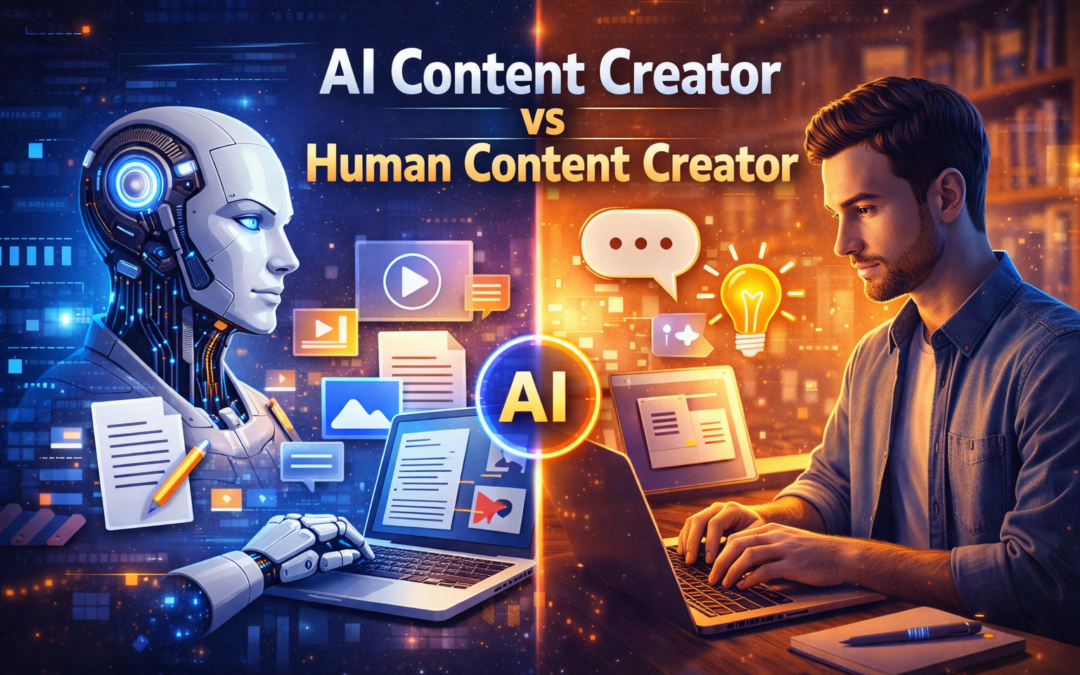
AI content creators use machine learning to generate text fast and cheaply. Human content creators bring real experience, emotion, and original thinking. AI wins on speed and scale. Humans win on creativity, trust, and quality. Most businesses today get the best results by combining both — using AI to draft and humans to refine.
The debate is everywhere right now. Should you use AI to create content? Or stick with human writers? Can AI really replace a skilled content creator?
These are real questions that businesses, marketers, bloggers, and brands are asking every day. And the answers are not as simple as you might think.
This guide breaks it all down. We will look at what each type of content creator actually does, where each one excels, where each one falls short, and how smart teams are using both together to stay ahead.
Whether you run a blog, manage a marketing team, or just want to understand the AI content revolution, this is the guide you have been looking for.
Contents
- 1 What Is an AI Content Creator?
- 2 What Is a Human Content Creator?
- 3 AI Content Creator vs Human Content Creator: Head-to-Head Comparison
- 4 Speed and Cost: Where AI Wins Big
- 5 Content Quality: Where Humans Still Lead
- 6 Creativity and Originality: Can AI Truly Create?
- 7 SEO Performance: Which One Ranks Better on Google?
- 8 Trust and Brand Voice: Why Authenticity Matters
- 9 Ethical Considerations: The Responsibility Gap
- 10 The Hybrid Model: AI and Human Working Together
- 11 The Future of Content Creation: What Comes Next?
- 12 Key Takeaways
- 13 Frequently Asked Questions (FAQs)
- 13.1 Can AI content creators fully replace human writers?
- 13.2 Is AI-generated content bad for SEO?
- 13.3 How can you tell if content was written by AI?
- 13.4 Which is more cost-effective: AI or human content creation?
- 13.5 What types of content should always be written by humans?
- 13.6 Does Google penalize AI-generated content?
- 13.7 What is the best AI content creation tool in 2025?
- 13.8 How do I use AI for content creation without losing quality?
- 13.9 Is AI-generated content considered plagiarism?
- 13.10 Will AI replace content creators in the future?
- 14 Final Word
What Is an AI Content Creator?
An AI content creator is a software tool powered by artificial intelligence — specifically a type of AI called a large language model, or LLM.
These tools are trained on massive amounts of text from the internet — articles, books, websites, social media posts, and more. They learn patterns in language and use those patterns to generate new text when you give them a prompt.
Popular AI content tools include ChatGPT by OpenAI, Claude by Anthropic, Gemini by Google, Jasper, Copy.ai, and many others.
You type in a request — say, ‘Write a 500-word blog post about healthy breakfast ideas’ — and the AI produces a draft in seconds.
What Can AI Content Creators Do?
- Write blog posts, articles, and website copy
- Generate social media captions and ad copy
- Draft email newsletters and product descriptions
- Summarize long documents or research papers
- Translate content into multiple languages
- Repurpose existing content into new formats
- Generate SEO metadata like titles and meta descriptions
- Create scripts for videos and podcasts
These tools are getting better fast. The output quality has improved dramatically in just the last two years. For many routine writing tasks, AI now produces content that is hard to distinguish from human writing at first glance.
What Is a Human Content Creator?
A human content creator is a real person who writes, edits, and publishes content. This includes freelance writers, in-house copywriters, journalists, bloggers, content strategists, and subject matter experts.
Human creators bring lived experience, judgment, and genuine emotion to their work. They can research a topic deeply, interview real sources, draw on personal stories, and adapt their tone based on deep audience understanding.
Great human content does more than relay information. It builds trust. It resonates. It feels real.
What Can Human Content Creators Do?
- Conduct original research and interviews
- Bring personal experience and authentic storytelling
- Understand and adapt to complex brand voices
- Make nuanced editorial judgments
- Build emotional connection with readers
- Navigate sensitive topics with care and context
- Create content that passes ethical and editorial standards
- Develop long-term content strategies
Human creators understand context in a way AI currently cannot. They know when a joke lands wrong. They recognize cultural nuance. They understand what a specific audience actually cares about — not just what the data says.
AI Content Creator vs Human Content Creator: Head-to-Head Comparison
Let us look at both side by side across the most important factors for content teams and businesses.
| Factor | AI Content Creator | Human Content Creator |
| Speed | Generates thousands of words in seconds | Takes hours or days per piece |
| Cost | Low — subscription or per-token pricing | High — hourly or per-project rates |
| Creativity | Pattern-based, limited true originality | Deep, original, and context-aware |
| Accuracy | Can hallucinate facts | Research-driven, fact-verified |
| Emotion & Tone | Simulated, often flat | Natural, nuanced, and authentic |
| SEO Optimization | Can apply rules at scale | Understands intent and audience depth |
| Personalization | Template-driven customization | Fully tailored to brand voice |
| Scalability | Extremely high | Limited by time and capacity |
| Ethical Risk | Bias, misinformation, plagiarism risk | Accountable and transparent |
Speed and Cost: Where AI Wins Big
This is where the gap is most obvious. AI is fast. Extremely fast.
A human writer might take three to six hours to research and write a solid 1,500-word article. An AI tool can produce a similar draft in under 30 seconds.
That speed difference compounds quickly. A content team that was producing 10 articles a month can now theoretically produce 100 — or more — with AI assistance.
Cost follows the same logic. A skilled freelance writer might charge anywhere from $0.10 to $1.00 per word, depending on their expertise. An AI subscription that costs $20 to $100 per month can generate hundreds of thousands of words.
For businesses that need high volumes of content — ecommerce product descriptions, local landing pages, FAQ sections — AI is a practical and cost-effective tool.
The Hidden Costs of AI Content
But speed and low cost come with a catch. AI content often needs editing before it is ready to publish. Errors slip in. The tone can feel generic. Facts get wrong.
When you factor in the time a human editor spends reviewing and fixing AI-generated content, the cost savings can shrink fast. For complex or high-stakes content, full human writing is often still the right call.
Content Quality: Where Humans Still Lead
Ask any editor who has worked with both AI drafts and skilled human writers, and they will tell you the same thing: the best human writing has a quality that AI has not yet matched.
Human writers can tell a story. They can make you laugh, make you think, or make you feel something. They choose words with precision and intention. They know when to be blunt and when to be gentle.
AI, by contrast, generates text by predicting what word should come next based on patterns it has seen before. The result can be technically correct but somehow flat. It follows the rules without understanding the spirit behind them.
The Hallucination Problem
One of the most serious quality issues with AI content is what researchers call hallucination. This is when an AI confidently states something that is simply not true.
It might invent a fake study, misquote a real expert, cite a website that does not exist, or give outdated statistics as if they were current. These errors are not always easy to spot, especially in complex or niche topics.
Human writers make mistakes too. But a professional writer is accountable. They have a reputation to protect. They double-check facts. AI tools do not have these instincts.
For content where accuracy matters — medical, legal, financial, technical — a human expert is not optional. The risk of AI error is simply too high.
Creativity and Originality: Can AI Truly Create?
This question goes deep. What does it mean to be creative?
AI tools are trained on existing human work. They remix, recombine, and regenerate. They can produce content that seems creative — a surprising metaphor, an unexpected angle, a clever headline. But at their core, they are working from patterns already established by human writers.
True creative originality — the kind that breaks conventions, challenges assumptions, or says something genuinely new — is still a human strength.
That said, AI can be a powerful creativity tool for humans. It can generate dozens of headline ideas in seconds, helping a writer find an angle they would not have thought of alone. It can brainstorm, draft, and ideate at a pace no human can match.
AI as a Creative Partner
The most productive way to think about AI creativity is not as a replacement for human imagination but as an amplifier.
A human writer with strong AI tools can explore more ideas, test more approaches, and refine their work more quickly than a writer working alone. The human provides the direction, the judgment, and the spark. AI provides the scale and the speed.
SEO Performance: Which One Ranks Better on Google?
This is one of the most debated questions in digital marketing right now.
Google has been clear: it does not penalize content simply because it was written by AI. What it penalizes is low-quality, unhelpful, or manipulative content — regardless of who or what created it.
But there is a nuance here that many people miss. Google’s ranking systems are increasingly built to reward content that demonstrates real experience, expertise, authority, and trustworthiness. This is what the E-E-A-T framework is about.
AI content can tick many of the technical SEO boxes — proper keyword placement, correct heading structure, appropriate length. But it struggles with the deeper signals that Google increasingly values: original research, first-person expertise, real quotes from real people, and content that goes beyond what is already out there.
The E-E-A-T Challenge for AI
Experience is the hardest E in E-E-A-T for AI to demonstrate. An AI has not used the product it is reviewing. It has not visited the destination it is describing. It has not treated the condition it is explaining.
Human writers who actually have these experiences bring something that AI simply cannot manufacture. A product review written by someone who really used the product for six months will almost always outperform an AI-generated review — in quality, in trust, and increasingly in rankings.
How AI Helps Human SEO Efforts
Where AI genuinely helps SEO teams is in the preparation work: researching keyword clusters, generating content briefs, identifying content gaps, drafting meta descriptions, and producing supporting content at scale.
Many SEO teams now use AI to handle the volume and humans to handle the depth. A human writes the cornerstone pillar content. AI helps fill in the cluster articles and supporting pages.
Trust and Brand Voice: Why Authenticity Matters
Your content is not just text on a page. It is your brand speaking to your audience.
Readers are becoming more sophisticated. They can often sense when content has been generated by a machine — not always, but enough to matter. Flat tone, generic examples, safe takes with no real point of view, oddly formal phrasing. These are signals that erode trust.
Brand voice is not just a set of style rules. It is the accumulated personality of your brand, built through countless editorial choices made by humans who understand your customers, your values, and your story.
AI can mimic a brand voice. It can follow guidelines. But authentic brand voice — the kind that builds real loyalty over time — is still a human achievement.
The Human Trust Advantage
When readers know a piece of content was written by a real expert who has lived experience with the topic, their trust increases. That trust translates to longer time on page, higher return visit rates, more shares, and better conversion rates.
This is why many high-performing content teams are now being very intentional about labeling expert-authored content and making their human writers visible — with author bios, credentials, and bylines.
Ethical Considerations: The Responsibility Gap
AI content creation raises real ethical questions that businesses should not ignore.
Bias and Representation
AI models are trained on human-generated data, which means they absorb human biases. They can reproduce stereotypes, underrepresent certain groups, or generate content that is culturally insensitive in ways that are not always easy to catch.
Human editors who are trained in ethical content practices are essential for catching and correcting these issues.
Misinformation Risk
AI that confidently generates false information at scale is a serious problem. In health, finance, law, and politics, bad information has real consequences for real people.
Human editorial oversight is not optional in high-stakes content domains. It is a responsibility.
Copyright and Originality
There are ongoing legal debates about the copyright status of AI-generated content and whether AI training on copyrighted material is lawful. These are not resolved questions.
Businesses using AI for content creation should stay informed about evolving laws and platform policies in their jurisdiction.
Transparency with Readers
Should you tell your readers when content was AI-generated? Many publishers believe yes — and some platforms are beginning to require it. Transparency builds trust, and deception, when discovered, destroys it.
The Hybrid Model: AI and Human Working Together
The false choice between AI and human content creation is being replaced by something smarter: the hybrid model.
Smart content teams are not choosing between AI and humans. They are building workflows that get the best from both.
What a Hybrid Content Workflow Looks Like
- Human content strategist defines goals, audience, and editorial angle
- AI generates a first draft or research outline
- Human writer refines, adds original insight, and injects authentic voice
- Human editor checks facts, tone, and quality
- AI assists with SEO optimization and metadata
- Human approves final piece for publication
This workflow captures AI’s speed and scale while preserving human quality and accountability. Experienced teams report that it can increase output by 40 to 70 percent without sacrificing content quality.
When to Use AI Content Creation
- High-volume, low-complexity content like product descriptions
- Initial drafts and outlines for human writers to refine
- FAQs and support documentation
- Repurposing existing human-written content into new formats
- A/B testing headline and copy variations
- Content localization and translation
When to Use Human Content Creation
- Thought leadership and opinion pieces
- Original research, case studies, and data journalism
- High-stakes content in health, finance, or legal fields
- Brand storytelling and founder narratives
- Long-form content that requires deep expertise
- Content requiring real interviews and primary sources
- Anything where your brand reputation is on the line
The Future of Content Creation: What Comes Next?
AI content tools are improving at a rapid pace. Features that were impossible two years ago are now standard. The gap between AI and human writing quality is narrowing in certain areas.
But the trajectory is not simple. As AI content becomes more common, original human content becomes more rare — and potentially more valuable. Audiences looking for genuine expertise, real stories, and authentic perspectives will pay a premium for the real thing.
Google and other search engines are refining their algorithms to detect and reward genuinely helpful, experience-backed content. This is not a coincidence — it is a direct response to the flood of AI-generated content now on the web.
The content creators who will thrive in the next decade are those who learn to use AI as a powerful tool while doubling down on the human qualities that AI cannot replicate: real experience, genuine voice, original thinking, and ethical accountability.
Skills Human Content Creators Need to Develop
- Proficiency with AI writing tools and prompt engineering
- Strong editorial judgment to evaluate AI output
- Ability to add original research and expert insight
- Deep understanding of audience intent and behavior
- Strategic thinking about content’s role in the larger business
Key Takeaways
- AI content creators excel at speed, scale, and cost-efficiency.
- Human content creators excel at creativity, accuracy, trust, and emotional connection.
- Neither is universally superior — context determines which is right for each task.
- The hybrid model combining both is the most effective approach for most businesses.
- Google’s E-E-A-T framework increasingly rewards genuine human expertise.
- Ethical risks of AI content — including misinformation and bias — require human oversight.
- The best content professionals of the future will be skilled at both.
Frequently Asked Questions (FAQs)
Can AI content creators fully replace human writers?
Not right now — and probably not anytime soon for complex, high-quality content. AI can handle routine writing tasks efficiently, but it lacks genuine experience, emotional intelligence, and the ability to produce truly original work. For thought leadership, expert content, and anything requiring real accountability, human writers are still essential.
Is AI-generated content bad for SEO?
Not automatically. Google does not penalize content just because AI wrote it. What matters is whether the content is helpful, accurate, and demonstrates genuine expertise. Thin, generic AI content with no original value will underperform. Well-edited, expert-reviewed AI-assisted content can rank well if it genuinely serves the reader.
How can you tell if content was written by AI?
There are AI detection tools available, but they are not perfectly reliable. Common signals in raw AI content include overly safe opinions, generic examples, repetitive sentence structures, and a lack of specific personal experience. As AI improves, the distinction becomes harder to spot without careful reading.
Which is more cost-effective: AI or human content creation?
For volume content like product descriptions or FAQ pages, AI is significantly more cost-effective. For high-value content that drives brand authority and conversion, the ROI of skilled human writers often justifies the higher cost. A hybrid approach typically delivers the best cost-per-result ratio.
What types of content should always be written by humans?
Medical advice, legal guidance, financial recommendations, mental health content, personal narratives, and any content where being wrong has real consequences for real people should always involve qualified human writers and editorial oversight. The same applies to investigative journalism and content based on original research or interviews.
Does Google penalize AI-generated content?
Google penalizes low-quality, unhelpful content regardless of how it was created. Publishing large volumes of unedited, generic AI content that adds no real value to readers will hurt your rankings. Content created with AI that is then refined, fact-checked, and enriched by human expertise can perform very well in search.
What is the best AI content creation tool in 2025?
The leading AI writing tools as of 2025 include ChatGPT (OpenAI), Claude (Anthropic), Gemini (Google), Jasper, and Copy.ai, among others. The best tool depends on your specific use case — some are better for long-form content, others for short copy or SEO workflows. Most professionals use more than one.
How do I use AI for content creation without losing quality?
Use AI for drafting, outlining, and idea generation. Always have a human review the output for accuracy, tone, and originality. Add specific examples, expert insight, and real data that the AI could not provide. Edit for your brand voice. This process gives you the speed benefits of AI while maintaining the quality that readers and search engines reward.
Is AI-generated content considered plagiarism?
This is a contested and evolving question. AI tools generate new text by predicting patterns rather than copying directly, but the training data includes copyrighted material. Some platforms have specific disclosure requirements. Academic institutions and publishers often prohibit undisclosed AI content. Always check the policies that apply to your context and be transparent with your audience.
Will AI replace content creators in the future?
AI will change what content creators do, but the evidence points toward augmentation rather than replacement for skilled creators. Demand for human expertise, original storytelling, and trustworthy voices is growing alongside AI adoption. Content professionals who learn to work with AI as a tool will be more productive and valuable — not less. The creators most at risk are those doing purely formulaic, low-judgment writing tasks that AI can now handle reliably.
Final Word
The AI vs human content creator debate is really a false choice. These are not two teams competing for the same job. They are two different types of capability that, when combined thoughtfully, produce better results than either could alone.
AI brings power. Humans bring purpose. Together, they can create content that is faster, smarter, more scalable, and still genuinely valuable to the people reading it.
That balance — technology in service of human quality — is where the future of content creation lives.
The best content strategy is not AI or human. It is AI and human, each doing what they do best.
createwithmegha.com is a content strategist and digital marketing consultant , helping brands build high-performing content programs. She has worked with startups, SaaS companies, and Fortune 500 teams to develop SEO-driven content strategies that drive real business growth. Sarah writes about AI, content marketing, and the future of digital storytelling. When she is not writing, she is testing the latest AI tools so her readers do not have to.